Disclaimer/Copyright Note : “This educational analysis, summaries, notes, questions, translations, and rephrased content are based on Chapter XI titled ‘In Father’s Presence’ from R.K. Narayan’s novel Swami and Friends (1935). All original ideas, characters, and text belong to the late author R.K. Narayan. This is prepared strictly for personal educational use by a 6th-standard student and does not claim ownership or replace the original work. No commercial use or plagiarism is intended. Readers are encouraged to read the full novel from authorised sources.”
This story is about a boy named Swaminathan (we call him Swami) in a hot town called Malgudi during summer holidays. He and his friends Mani and Rajam love playing outside even in the burning sun. They stop a poor cart driver, pretend to be police, and give him a funny fake pass after teasing him about his bullock. Then Swami’s dad’s court closes, so dad stays home and catches Swami trying to sneak out. Dad sees dusty books full of spider webs and gets angry. He makes Swami sit right there and do maths sums about a man named Rama and mangoes. Swami gets totally confused – should he add, subtract, or what? He keeps thinking about eating the juicy mangoes instead of doing fractions! Dad is strict but patient and keeps explaining. Swami feels trapped but tries hard. In the end, he starts studying a bit more. It’s funny and a little scary because dads can be tough teachers!
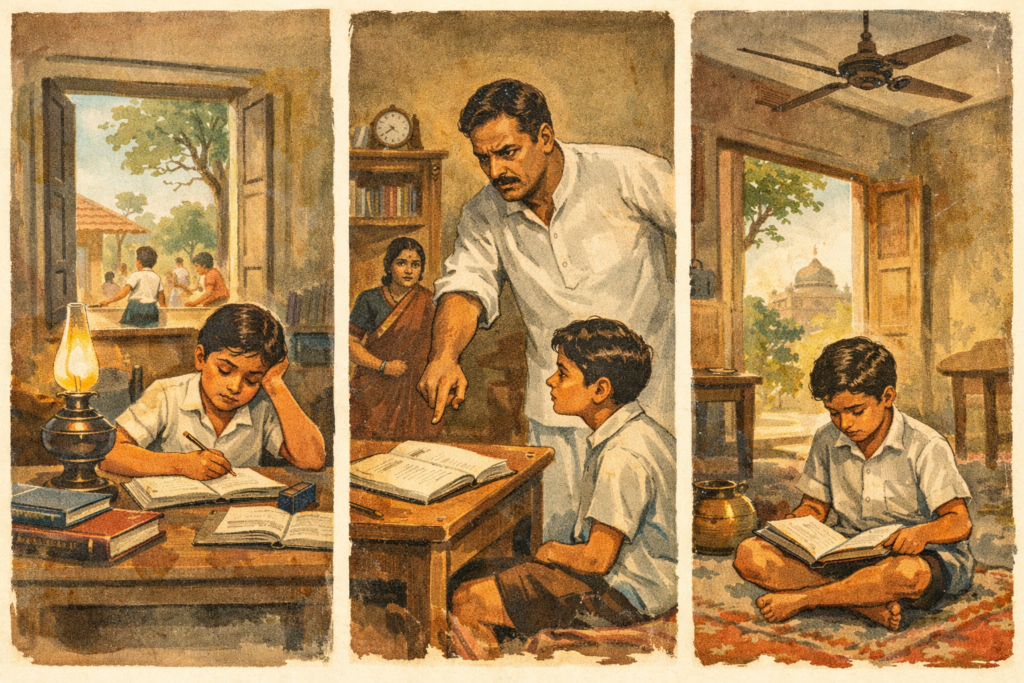
In R.K. Narayan’s Swami and Friends, Chapter XI “In Father’s Presence” juxtaposes carefree childhood freedom with the sudden intrusion of adult authority during the oppressive Malgudi summer. The opening vignette shows Swami, Mani, and Rajam playfully impersonating police officers to harass a cart driver, highlighting the boys’ imaginative rebellion and camaraderie amid the heat that adults find unbearable. The narrative pivot occurs when Swami’s father, a court employee on vacation, discovers his son’s neglected, dust-laden books and spider-webbed study corner. What follows is a tense tutorial session in arithmetic (profit-loss involving Rama’s mangoes and fractions), exposing generational gaps in empathy, the psychological pressure of parental expectations, and the child’s internal conflict between rote learning and sensory longing. Narayan masterfully employs ironic humour and subtle realism to underscore themes of childhood anxiety, the rigidity of colonial-era education, and the quiet evolution of father-son dynamics through patient insistence rather than punishment.
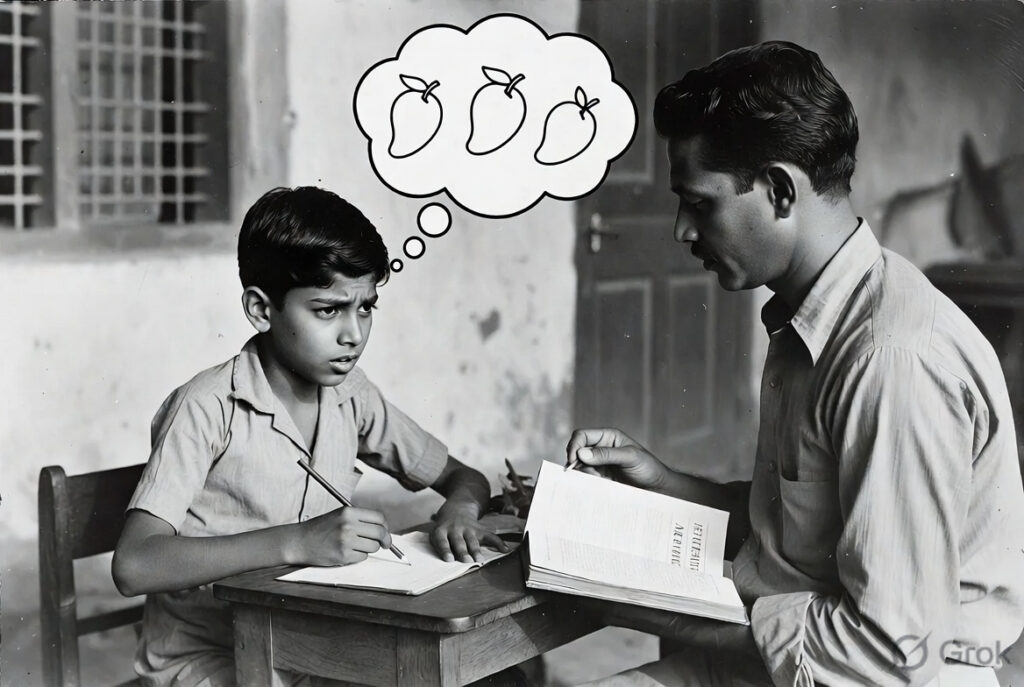
Swami, however, is a child of Malgudi whose mind naturally wanders into stories, characters, and sensory details. The problem about mangoes becomes, for him, a miniature drama about people, fruits, and fairness, not a neat equation. As the father’s gaze grows heavier and the silence stretches, Swami’s anxiety amplifies until he can no longer function “logically.” His tears are the collapse of performance under pressure, not laz spices.
From a mature perspective, R. K. Narayan uses this scene to critique adult‑centred education that forgets the child’s psychology. The story becomes a quiet study of fear, expectation, and the difference between what adults call “common sense” and what children experience as very real emotional stress.
Notes
- Setting: Hot summer in Malgudi (1930s small Indian town); dusty roads, no school, fan not working.
- Main Characters: Swaminathan (Swami – lazy, dreamy, scared of maths), Father (strict but caring teacher), Mother & Granny (supportive but don’t help much), Friends Mani & Rajam (fun-loving).
- Plot: Boys’ mischief → Father catches Swami → Forces study → Maths struggle with mango sum → Swami confused but tries.
- Theme: Hard work in holidays, father’s love through discipline, childhood vs. duty.
- Message: Parents want the best even if it feels boring; little efforts add up.
- Author: R.K. Narayan – famous for Malgudi stories, simple English with Indian life.
- Setting: A middle‑class Indian home in Malgudi, during hot summer holidays.
- Characters:
- Swaminathan (Swami): sensitive, imaginative, easily frightened 10‑year‑old boy.
- Father: serious, strict, believes in discipline and logic.
- Theme: Fear of authority, pressure to perform, clash between imagination and logic, child psychology vs adult expectations.
- Tone: Lightly humorous at first, then tense and emotional; ends with a hint of sympathy.
- Plot shape:
- Ordinary holiday scene → father decides to test maths → boy panics → misunderstands the sum → father grows impatient → boy cries → emotional release.
Word meanings
- Detested: hated a lot
- Blanched: turned white/pale from heat
- Vagrant: wandering without home
- Culvert: small bridge over drain
- Stubble: dry leftover crop
- Loafing: wasting time idly
- Pestered: annoyed again and again
- Scandalous: very shocking and wrong
- Avrice: greedy (wait, avarice)
- Woebegone: looking very sad and unhappy
- Fractions: parts of a whole number
- Proportion: comparing two things
- Arithmetic – the part of maths that deals with numbers and calculations.
- Pestered – to keep bothering someone in a way that irritates them.
- Fractions – parts of a whole; for example, half, quarter, or one‑third of something.
- Reluctant – not willing to do something; feeling a bit unwilling.
- Industrious – very hard‑working and careful in doing work.
- Scandalous – something shocking or socially wrong.
- Realm – a particular area or field of knowledge or activity.
- Improbable – very unlikely; not probable.
- Woebegone – looking very sad and unhappy.
- Avarice – strong greed for money or possessions.
- Invest (in this context) – to put money into something expecting a return; to spend money wisely.
- Discipline – rules and control Authority – power to control Embarrassed – feeling ashamed Nervous – anxious or afraid Strict – very firm
| Gaze | To look steadily | Swami looking at the book. |
| Obstinate | Stubborn | How the math problem seemed. |
| Grotesque | Very strange/ugly | The way the figures looked to Swami. |
| Flushed | Red in the face | Swami’s face when he was crying. |
| Relentless | Not stopping | Father’s questioning. |
- Hindi: स्वामी छुट्टियों में पढ़ना नहीं चाहता था, लेकिन उसके पिता ने उसे अनुशासन सिखाने के लिए मजबूर किया। कहानी में पिता की सख्ती और बच्चे की मासूमियत दिखाई देती है।
- Marathi: सुट्टीत स्वामी अभ्यास करू इच्छित नव्हता. पण वडिलांनी त्याला शिस्त शिकवण्यासाठी जबरदस्ती केली. यात बालपणाची निरागसता आणि पालकांचे अधिकार दाखवले आहेत.
- Kannada: ರಜಾದಿನಗಳಲ್ಲಿ ಸ್ವಾಮಿ ಓದಲು ಇಷ್ಟಪಡಲಿಲ್ಲ. ಆದರೆ ತಂದೆ ಅವನಿಗೆ ಶಿಸ್ತು ಕಲಿಸಲು ಬಲವಂತ ಮಾಡಿದರು. ಕಥೆಯಲ್ಲಿ ತಂದೆಯ ಕಠಿಣತೆ ಮತ್ತು ಮಗುವಿನ ನಿರಪರಾಧಿತನವನ್ನು ತೋರಿಸಲಾಗಿದೆ.